Ship & Vessel
Deep Cleaning
Specialized ultra-high-pressure decontamination, hull biofouling stripping, and certified confined-space extraction engineered for deep-draft commercial ocean carriers, chemical tankers, and Great Lakes bulk vessels.
Extreme Pressure.
Zero Abrasion To Underlying Alloy.
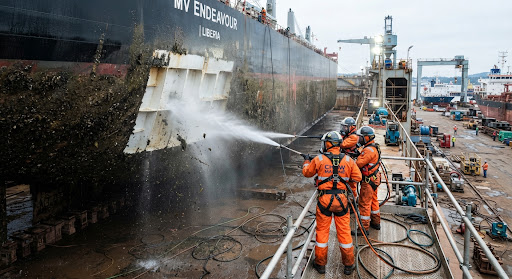
Marine asset downtime is governed by dock-gate turnover velocity. Chow Marine deploys hydro-lancing manifolds, continuous magnetic wall crawler units, and vacuum-recovery blasters capable of peeling maritime bio-fouling, calcified zebra mussel colonies, and degraded epoxy coatings down to pure metallurgical white metal without degrading the ship's base tensile steel plate.
From Great Lakes multi-cargo carriers carrying calcined petcoke to trans-oceanic liquid tankers requiring zero-hydrocarbon fuel tank swaps, our crews utilize Class 1 Div 1 certified intrinsically safe hydro-extraction systems. Every gallon of blast fluid is scrubbed on-site through our mobile multi-stage hydro-cyclone filtration units, delivering closed-loop environmental compliance directly over port wharves and drydock floors.
Operational Environments & Zones
Marine decontamination requires purpose-engineered protocols tailored to each compartmental profile, avoiding hot-work permits, mitigating static discharge, and maintaining continuous gas scrub telemetry.
Cargo Holds & Double Bottoms
High-volume clearance of compacted corrosive petcoke, sulfur cakes, and raw bauxite ores. Automated rotary tank heads deploy without spark hazards or hazardous hot-work certifications, allowing immediate backhaul re-certification.
Hulls, Keels & Running Gear
Hydrodynamic cavitation and 40,000 PSI hydro-demolition stripping away severe invasive bio-growth, barnacle anchors, and multi-layered anti-fouling blister coatings down to raw steel for ultrasonic wall gauging inspections.
Ballast & Heavy Fuel Tanks
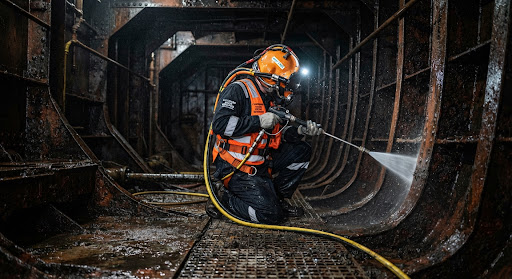
Confined-space certified breathing-air entry crews operating specialized hazardous waste positive-displacement sludge pumps. Extracting heavy paraffin waxes, asphaltic bottoms, and anaerobic sediment without harbor contamination.
Bilges, Piping & Sea Chests
Hydro-degreasing of high-viscosity lube oil bilges, marine growth strainer extraction, and chemical cleaning of sea chests. Integrated with closed-circuit skimming rigs that isolate oily residue from harbor water basins.
Engineered Mobilization Protocol
Atmospheric Gas Logging & Isolation
PID photoionization detectors and calibrated 4-gas monitoring systems test all compartment sectors for VOCs, H₂S, and lower explosive limits (LEL) prior to crew entry or power connection.
Vacuum Bunding & Closed Containment
Deployment of floating marine boom containment barriers and positive vacuum shroud systems around sea chest discharges to intercept wash slurry before it interacts with port waters.
Robotic & Manual 40,000 PSI Jetting
Robotic vertical crawlers navigate external vertical sideshell plates while certified blaster specialists strip framing webs, transverse bulkheads, and deep cargo wells using high-velocity spin nozzles.
NACE Profiling & White Metal Signoff
Bresle patch soluble salt sampling and digital surface profile gauges document surface cleanliness. Full electronic signoff handed over to Vessel Superintendent and Class Surveyors.
Adjacent Capabilities
Oil Rig & Offshore Platform Decontamination
Severe NORM decontamination, moonpool biofouling extraction, and drilling mud pit clearance executed by offshore-badged rope access certified teams.
Marine Structural, Pier & Caisson Services
Sub-surface pier pile scouring, drydock caisson gate bio-demolition, and lock chamber high-pressure cleaning along St. Lawrence Seaway corridors.
Require Rapid Ship Cleaning Or Drydock Mobilization?
Dispatch engineers are available 24/7/365 to assess berth specifications, calculate wastewater holding requirements, and mobilize multi-lance crews to any Canadian or US Great Lakes / Atlantic port.